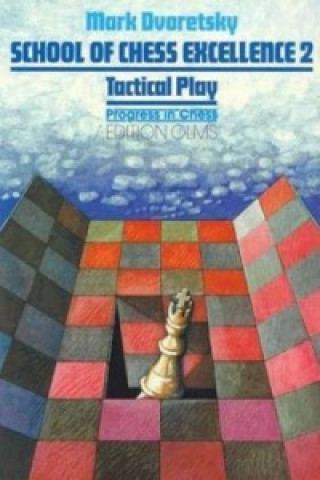
Carte : School of Chess Excellence 2 - Tactical Play - Mark Dvoretsky
1 offer · cheapest first · prices may exclude shipping
About this product
Mark Dvoretzky is regarded as the leading chess coach in the world and in this series of books he reveals the training methods that have transformed so many of his pupils into champions. The initial part of this book deals with combinations and tactical techniques, and suggests methods for developing a player 39;s calculating ability. In the second part the author analyses a number of fascinating examples, in which he examines a wide variety of attacking and defensive means. Once again, the reader is encouraged to developing his understanding by tackling numerous tests. Join in and become one of Mark Dvoretsky 39;s pupils! This book is also available in the German edition under the title Moderne Schachtaktik. Contents 007 Foreword Part four 009 Combinations and the calculation of variations 010 Combinative vision 020 Spots on the sun 023 Twin combinations 027 A prompt 030 Candidate moves 039 Paying attention to the opponent 39;s possibilities 045 The method of elimination 050 Double attack 055 The trapped piece 059 The strength of a passed pawn 063 Don 39;t let the king interfere! 066 Learn from your mistakes! 071 Beware - a trap! 075 Logic or intuition? 080 The checking of exercises 087 Is there a solution to the problem? 090 How many roads lead to Rome? 094 39;Difficult in training - easy in battle! 39; 099 A combination which is impossible to find 105 A game played several times 112 Playing exercises 118 Exercises for analysis Part five 121 Attack and defence 122 Sacrifice or oversight? 126 39;All that glitters is not gold 39; 130 Ten years later 133 Twenty years later 137 A pawn in return for castling 140 Was the attack irresistible? 144 Does the 39;ideal 39; style exist? 151 Fantastic! 158 Victory in the romantic style 162 Two attacks by Reiner Knaak 165 Djin attacks! 168 A decisive game 174 The spectators were delighted 184 Diamond cut diamond 187 The psychology of defence 193 Into the storm! 200 Bluff! 203 On the edge of the abyss 209 The positional exchange sacrifice 213 Two 39;French 39; endgames 217 It really is better to give up a pawn 222 Form your own opinion 231 Exercises for analysis 233 Solutions to exercises Appendix 260 Index of exercises by thinking skills and types of problems to be solved 262 Index of players Foreword My friends tried many times to convince me of the need to put down on paper at least part of the quite substantial material that I have accumulated during the course of my training work. In principle I agreed with them, but I did not have a very clear impression of the appropriate way of doing this. To give a consistent account of my entire concept of training, preparing something akin to a new version of Nimzowitsch 39;s famous 39;My System 39;, was something that I simply could not bring myself to do. But I also did not want to restrict myself to describing some small province of the extensive and fertile kingdom of chess. Finally, some kind of writing plan occurred to me. When I sat down at my desk, I quickly realised that this plan could not be accommodated within the framework of one book. In the end I have written four, united under the general title 39;School of Chess Excel lence 39;. In 1991 the publisher Batsford brought out my first work 39;Secrets of Chess Training 39;. It was a success with the readers, and was even judged 39;best book of the year 39; by the British Chess Federation. The book which you now have before you continues the previous, Volume 1 in the series, and in it there are numerous references to general rules, techniques or even specific examples, that have already been examined. But before talking about it, I should like to explain the overall idea of this series. Strictly speaking, there is not just one, but several ideas. 1) Fresh material. I mainly use the games of my pupils (in particular, Artur Yusupov and Sergey Dolmatov: at one time participants in junior tournaments, and subsequently grandmasters, and candidates for the world championship), or my own games. Examples from the games of other players are given only in those cases when we (I or one of my pupils) were able to look at them with new eyes, and correct and add to other analyses. I invite the reader into our creative and analytical laboratory, and offer original chess material, which will not be found in other books. 2) The art of analysis. It is clear that, with such an approach to the selection of material, considerable attention must be devoted to the process of chess analysis, to the technique of its implementation, to typical mistakes in analysis, and so on. I do not want to expand here in detail about the importance of analytical mastery for any player. I will merely cite the opinion of Garry Kasparov: 39; consider that, other things being equal, the analytical approach, the analytical method of studying chess, must
Product data provided by magazinuldesah.ro.